


| Key Summary
Many financial decisions in everyday life are guided by hope. We hope income will continue, expenses will stay manageable, and emergencies won’t happen. But strong financial stability usually comes from awareness, not hope. In this blog, we explore the difference between financial awareness and hope, why this mindset matters, and how small awareness-driven decisions can help families build stronger financial confidence over time. |
The Silent Driver Behind Many Financial Decisions
Let’s start with an honest question.
When it comes to money, are your decisions based on planning or hope?
For example:
- “Income toh chalti hi rahegi.”
- “Emergency aayegi hi kyun?”
- “Savings baad mein bhi ho jayegi.”
These thoughts are very common.
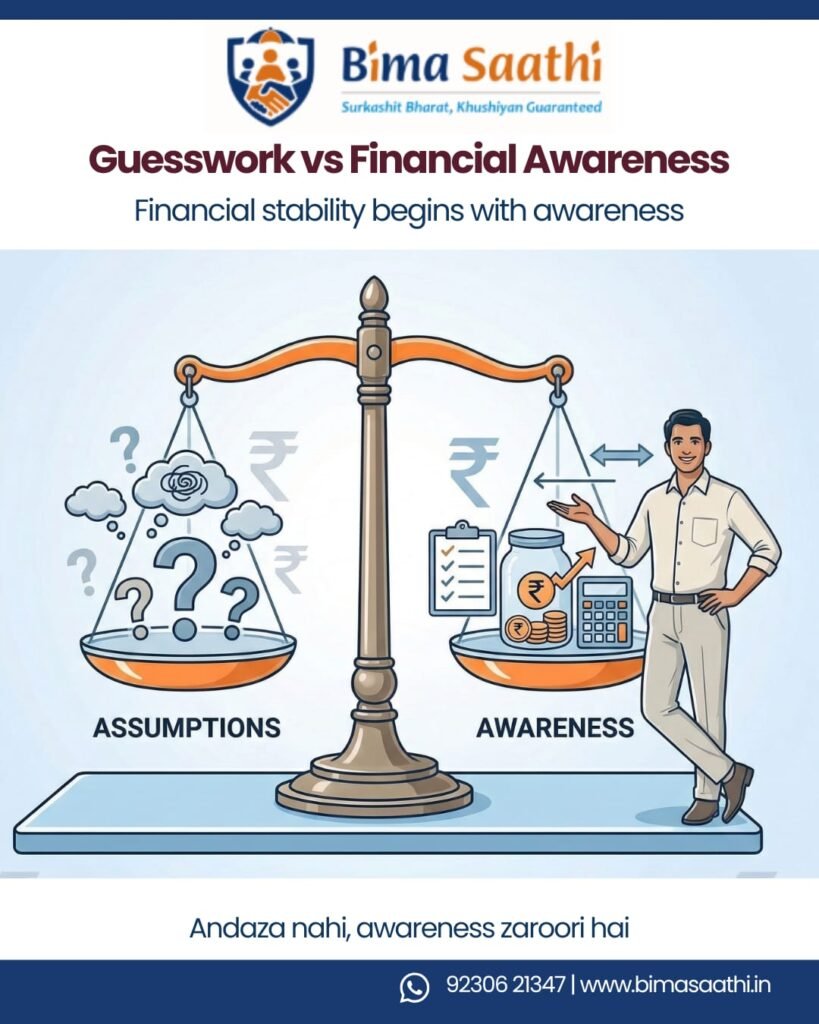
In fact, many households unknowingly run their finances based on hope rather than financial awareness.
And hope is not a bad thing.
Hope gives optimism.
Hope keeps us positive.
But when it comes to financial decisions, hope alone cannot replace awareness.
“Umeed zaroori hai. Par planning usse bhi jyada zaroori hai.”
Also Read: Are You the Earning Pillar of Your Family?
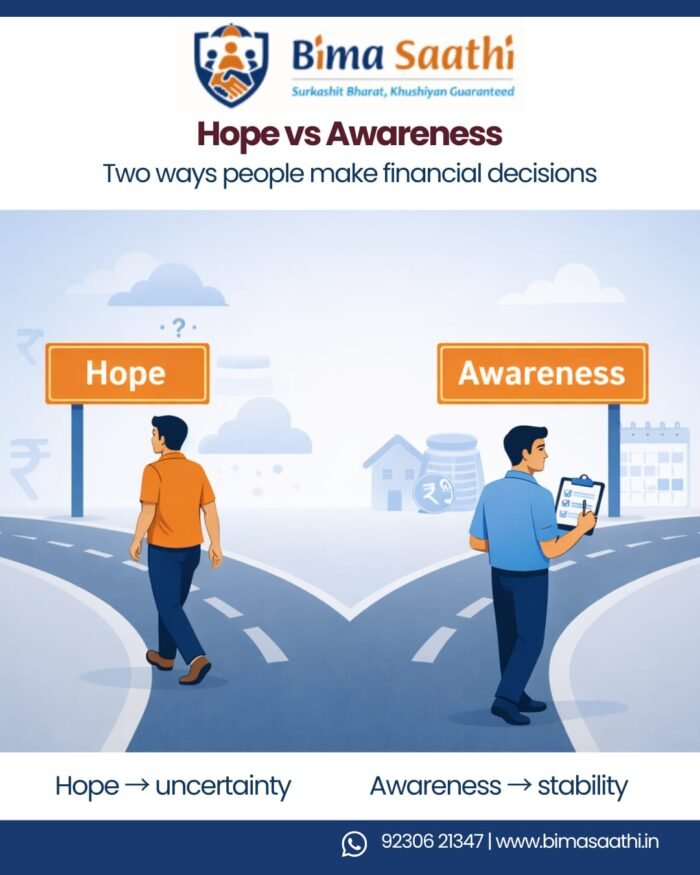
Understanding the Difference: Hope vs Awareness
Let’s simplify this.
Hope-driven thinking
Hope-based financial thinking sounds like this:
- “Sab theek hi rahega.”
- “Income rukne ka chance hi kya hai.”
- “Emergency ke time kuch na kuch ho hi jayega.”
Hope assumes that things will go smoothly.
Sometimes they do.
But sometimes life surprises us.
Awareness-driven thinking
Financial awareness asks a different question:
“What if something changes?”
For example:
- If income pauses temporarily
- If medical expenses increase
- If family responsibilities grow
Awareness does not assume the worst.
It simply prepares for possibilities.
“Awareness, future ki preparation hai.”
Why Financial Awareness Matters More Today
Financial life today is more complex than before.
According to industry estimates:
- Over 8 crore SIP accounts are active in India.
- Health insurance awareness increased significantly after COVID.
- Household financial participation in investments is steadily rising.
This shows one thing.
People are becoming more financially aware.
But in many Tier II and Tier III towns, financial planning conversations still revolve mainly around:
- Property
- Gold
- Short-term savings
The deeper questions about income stability and long-term protection are often left unasked.
That’s where financial awareness becomes powerful.
The Maturity Test of Financial Decisions
Financial maturity is not about earning a lot.
It is about thinking responsibly about money.
Ask yourself these questions:
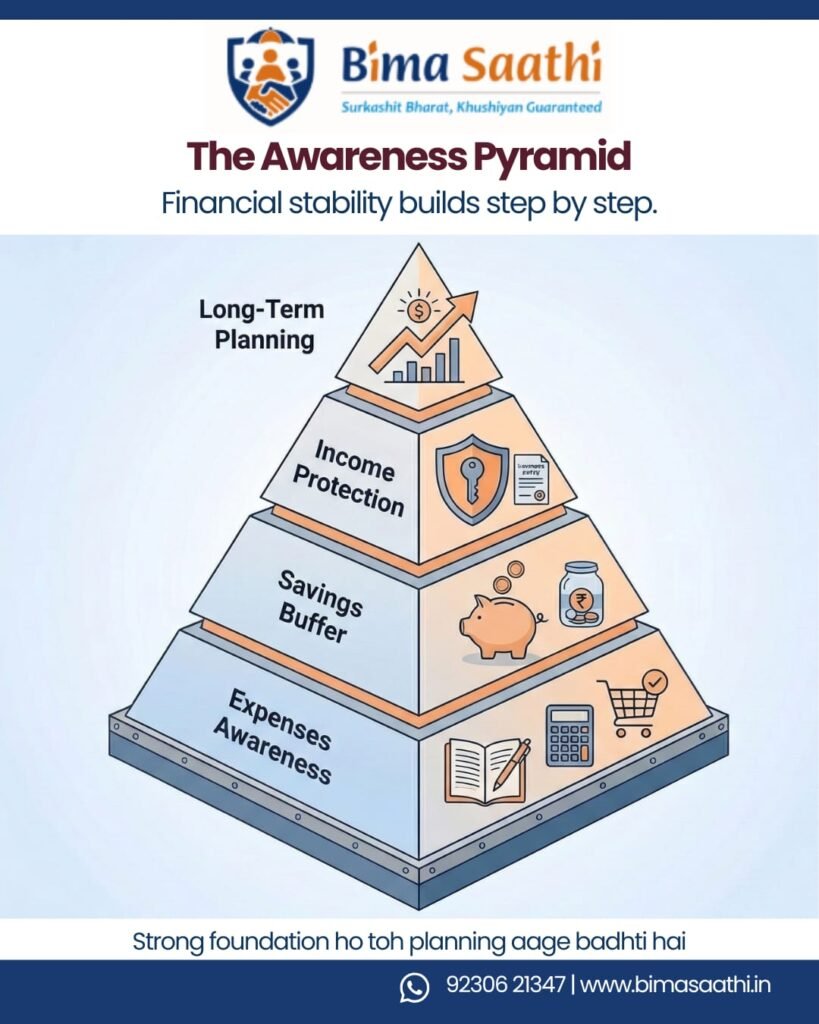
- Do I know my monthly essential expenses clearly?
- Do I have an emergency buffer?
- Have I thought about Income Continuity if my earnings pause?
- Have I considered Income Protection for unexpected situations?
These questions shift financial thinking from hope to awareness.
Awareness Creates Confidence
One interesting thing happens when people become financially aware.
Fear reduces.
Why?
Because uncertainty reduces.
When you know:
- Your savings capacity
- Your monthly commitments
- Your risk exposure
You feel more in control.
Financial awareness does not create stress.
It actually reduces stress.
Awareness is Not About Fear
Sometimes people misunderstand financial awareness.
They think it means worrying about every possible problem.
Not at all.
Awareness is simply about asking:
“Am I prepared if things change?”
Life rarely follows a perfectly predictable path.
But preparation makes changes manageable.
“Planning dar se nahi, zimmedari se aati hai.”
Small Awareness Steps That Make a Big Difference
Financial awareness does not require complicated strategies.
Start with simple steps.
Step 1: Write down your monthly essential expenses.
Step 2: Calculate how many months your savings can support the household.
Step 3: Discuss financial responsibilities openly within the family.
Step 4: Understand the role of protection in financial stability.
Small awareness habits create strong financial foundations over time.
Hope is Good. Awareness is Better.
Hope keeps us positive.
But awareness keeps us prepared.
When both work together, financial life becomes balanced.
You can dream confidently because your foundation is stable.

Final Thought
Every financial decision ultimately comes down to a simple question.
Is it driven by hope or awareness?
Hope says:
“Sab theek rahega.”
Awareness says:
“Agar kuch badla toh plan kya hai?”
Both have a place in life.
But financial stability grows when awareness guides our decisions.
No panic.
No complexity.
Just responsible thinking.
“Financial awareness ek habit hai. Aur habits hi future banati hain.”
Also check: Become A POSP
Frequently Asked Questions
Q1️. What is financial awareness vs hope in financial decisions?
Financial awareness vs hope refers to the difference between making financial decisions based on planning and understanding rather than relying only on optimism.
Q2️. Why is financial awareness important for families?
Financial awareness helps families understand expenses, risks, and responsibilities, allowing them to plan better for unexpected situations.
Q3️. How can POSPs promote financial awareness?
POSPs can encourage financial awareness by asking thoughtful questions and helping families understand stability, protection, and long-term planning.
Q4️. Is financial awareness only about investments?
No. Financial awareness includes understanding income stability, expenses, savings, and protection strategies.
Q5️. Can small financial awareness habits make a difference?
Yes. Simple steps like tracking expenses, building emergency savings, and discussing financial plans can significantly improve financial stability.
If you want to understand your financial decisions with more clarity and awareness:
Connect with BIMA SAATHI.
We believe in calm conversations, simple explanations, and responsible guidance.
📞 Call: +91 92306 21347
📧 Email: support@bimasaathi.in
🌐 Visit: www.bimasaathi.in
📍 Speak to your nearest BIMA SAATHI representative
Decision aapka hoga. Saath hum denge.

Leave A Comment